I looked at a photograph from ten years ago recently. Same face, more or less. Same general configuration. But something fundamentally different in the eyes — a quality I can only describe as the absence of certain urgencies I used to carry everywhere.
I used to be in a hurry to prove something. I don't remember what. Something about being good enough, probably. About deserving the room I took up. I've mostly stopped doing that, and the poems have gotten better since I stopped.
The thing I notice most when I compare older photographs to my current face is not age exactly. It is pressure. There used to be a visible pressure in me, a forward-leaning urgency that had not yet learned the difference between conviction and strain. I do not say that critically. That earlier version of me was doing her best with the tools she had. But I look at her now and feel tenderness more than nostalgia. She thought she needed to prove far too much, far too often.
Change of the good kind is usually quiet enough that you miss it while it is happening. It gathers by repetition. You survive enough difficult seasons, stop chasing a few false measures, accept help where you once would have performed independence, and one day the face in the mirror is carrying less panic than it used to. Not no grief, not no uncertainty, but less panic. June 2025 felt like one of those threshold months for me. I had already changed in ways the hard year required, but in June I could finally recognize some of the change as gain instead of merely loss.
That is important to say out loud because so much writing about transformation gets trapped in before-and-after rhetoric. Life is not a makeover montage. We do not become new all at once. We become more ourselves by relinquishing urgencies that were never actually protecting us. I think that is what I saw in the photograph and in the mirror afterward: fewer unnecessary defenses. Less need to earn my own existence. More willingness to occupy my life without constant argument.
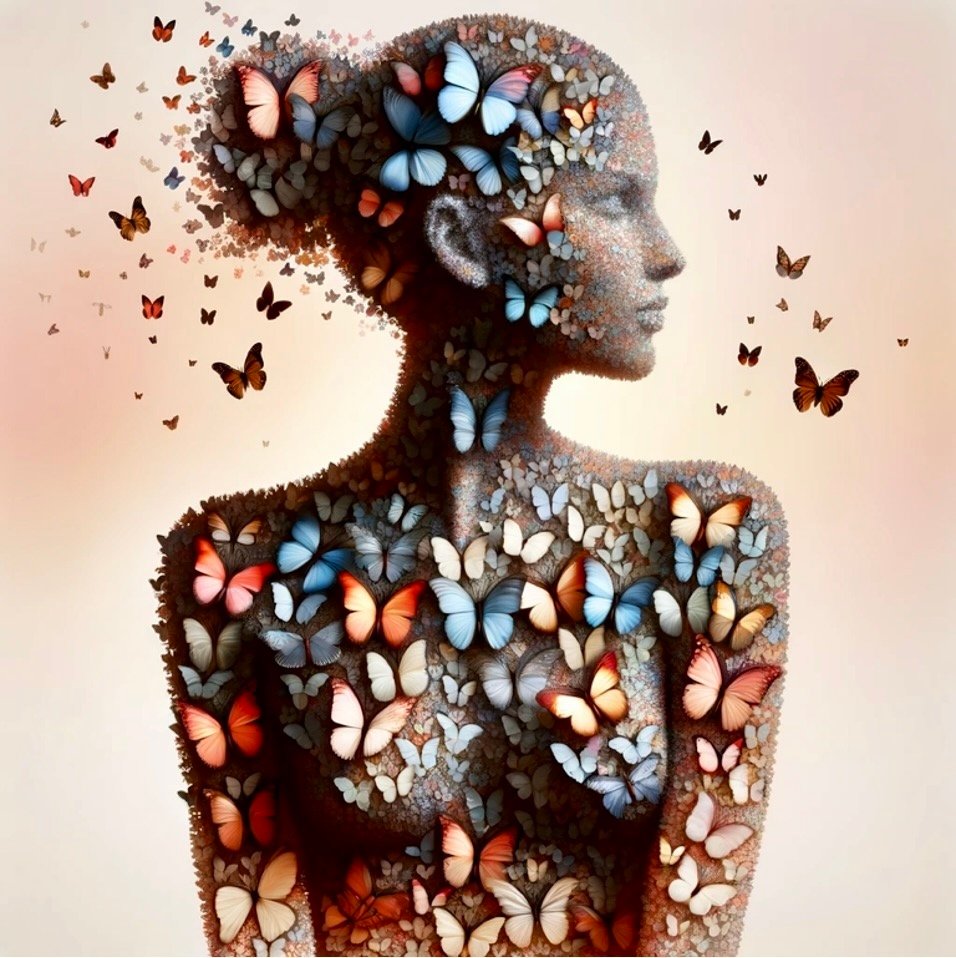
In the Hush of Dawn, Metamorphosis
In the hush of dawn, metamorphosis spun, A silent silhouette against the waking sun. With whispered hues and wings unfurled, A being transcends the tethered world.
Coming soon — included in What Remains of UsIn the Hush of Dawn, Metamorphosis belongs here because the poem understands change as a morning event rather than a public performance. Wings unfurl in the waking light. The shift is real, but it is also tender, gradual, and almost private. That is the emotional truth of this entry. I am not the same anymore, and thank God for that, but the goodness in the change came quietly. It arrived in the hush before anyone was applauding.
I do not think the goal is to become unrecognizable to yourself. I think the goal is to become more accurately recognizable. The better self is not fabricated; it is revealed. June let me see some of that revelation clearly enough to trust it. That is why the entry belongs on the timeline in fuller form. It marks a good kind of unfamiliarity: the realization that you have changed and that the change, on balance, has made you kinder company for your own life.
That kinder company matters more than accomplishment metrics ever did. You can build an impressive life and still be inhospitable to yourself inside it. I know because I have done versions of that. What felt new in June was the sense that the internal room had become more livable. Less self-surveillance, less needless intensity, more permission to be present without turning presence into another performance. If transformation means anything to me now, it means that kind of inward mercy. It deserves to be part of the record in plain language.
Who are you becoming? Not who were you. Who are you becoming? That's the poem. That's always the poem.
Yours, in ink and embers,