Every poet eventually has to decide what to do with love. It is the subject that has been written about so thoroughly, from every angle, in every language, across every century of human experience, that adding to it seems almost arrogant. And yet we keep doing it. Every last one of us.
I think we do it because love keeps changing on us. It is not one thing. It is the best and worst of everything, sometimes in the same afternoon, and every time it shifts you find yourself with new material and the same impossible task: try to say it.
Love is impossible as a subject precisely because it is never one subject. By the time you think you have it cornered, it has changed register again and become grief, tenderness, hunger, repair, patience, fury, or some unhelpful combination of all of them before lunch. That is why poets keep returning to it even after centuries of evidence that the field is impossibly crowded. The work is not to say something no one has ever said. The work is to say what this version of love feels like from inside your own body and time.
I mistrust easy love poems for the same reason I mistrust easy love in real life. If nothing is at stake, I start wondering whether anyone has actually looked closely enough. The poems I keep are the ones willing to admit that love is equal parts blessing and complication, that it can fill a life and unmake a day in the same motion. Those contradictions are not a flaw in the subject. They are the subject. Every time I write toward love, I am trying to honor its mixed weather without flattening it into either cynicism or greeting-card sweetness.
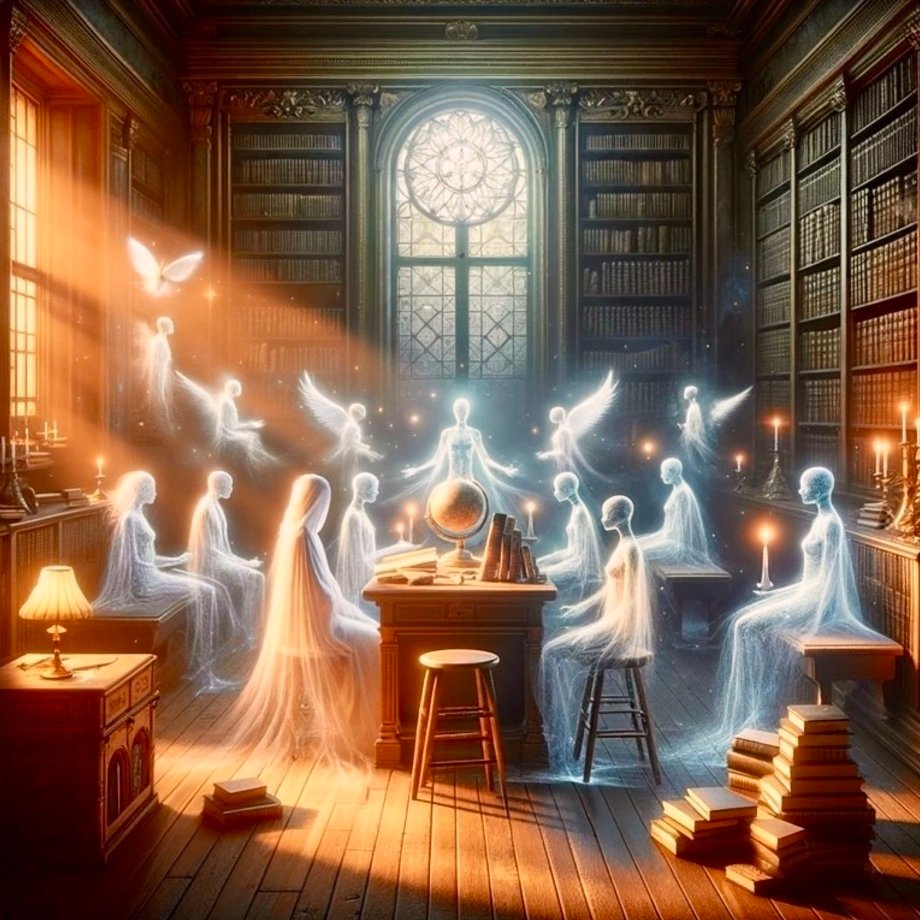
Guardians of the Mind's Realm
In the mind’s halls, tread with care, For thoughts are tenants with stories to share. Welcome the ones with light and song— Turn away shadows where they don’t belong.
Coming soon — included in Echoes From the HeartThe hands almost touching in the image mattered because the gap is where most of the real emotional charge lives. Fulfillment is not the only meaningful state. Anticipation, restraint, near-contact, the ache of what has not yet closed distance—those are often more recognizably human than a perfectly resolved embrace. I wanted the image to hold that suspended truth because the poem lives there too. Love is often not in the moment of certainty. It is in the space before certainty, when you still have to choose whether to move closer and mean it.
I do not think I will ever finish writing about love, and I take that as a good sign. A subject that large should stay larger than the writer trying to address it. If it ever becomes easy, I will assume I have drifted away from the actual thing and into a decorative copy. Until then, I will keep returning to it the same way everyone else does: reluctantly, repeatedly, and with the odd gratitude of knowing the difficulty is proof that the subject is still alive.
Maybe that is the only honest ambition with love poems: not to master the subject, but to keep meeting it without lying. Some days that means writing from the ache. Some days from the devotion. Some days from the bewilderment of how quickly one can become the other. I will take all of that over a tidy answer every time, because untidy is where love is most recognizably itself.
Write about love. Write about it badly, first. Write about it seven times and throw away six. The seventh one will be true enough to matter.
Yours, in ink and embers,