I was near the Jemez Mountains the summer a wildfire moved through. I was not in danger — I want to be clear about that. But I watched from distance as a hillside I'd hiked became something else entirely. And what I kept thinking, watching the smoke, was: something is happening here that isn't only destruction.
That thought became a poem.
Watching fire at a distance is a strange moral position. You are close enough to feel implicated by it and far enough to know the event is not yours in the most direct sense. I was near the Jemez Mountains when the wildfire moved through, and that tension stayed with me. I did not want to turn someone else's emergency into my metaphor. At the same time, I could not ignore the force of what I was witnessing. Fire rearranges scale instantly. It turns hillsides into process. It makes you aware of time in a harsher register than most weather ever does.
What I could not stop thinking about, though, was the refusal of the landscape to be reduced to destruction alone. Even before the full aftermath had settled in, there were signs of life already moving toward the burned ground. That did not sentimentalize the damage. It did, however, complicate the story in a way I trust. I am always suspicious of metaphors that flatten reality into a single lesson. Fire is not only loss. Regrowth is not only hope. The truth lives in the middle, in the period where the ground is still black and something green has the audacity to arrive anyway.
That is why the silhouette mattered in the image. I needed the between-state, not the clean before or after. The poem belongs to the roaring middle, the part where certainty is unavailable and yet life is already arguing for itself. That middle is familiar to anyone who has moved through grief, illness, upheaval, or any season where you know something essential is changing before you can say what the new shape will be. The fire gave me that visual grammar in a way my own life had already been teaching me by other means.
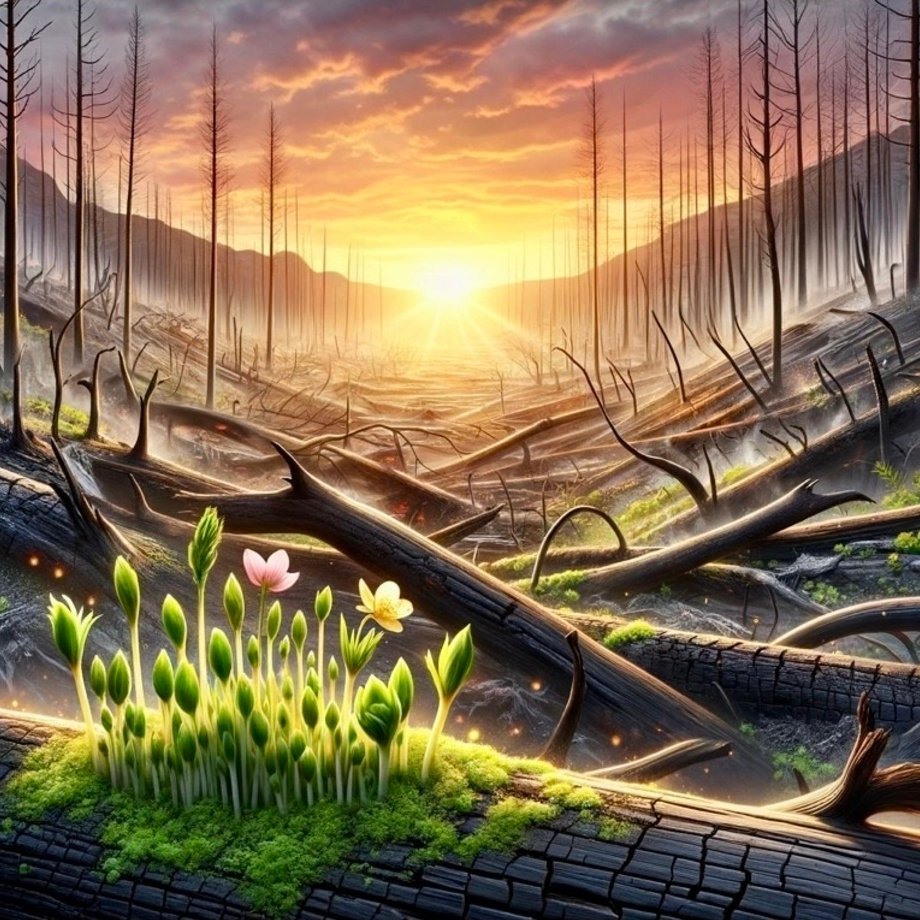
Roaring Silhouettes
In the roar of tongues aflame, Life's silent gestures stake their claim. Though flames may dance and sing their song, They cannot own the life that's long.
Coming soon — included in Echoes From the HeartI am glad I stayed suspicious of the metaphor even while using it. Suspicion kept me accurate. It made me return to the specifics: the distance, the smoke, the hillside, the first green refusing permission. Accuracy matters most when the subject is large enough to tempt you into easy symbolism. The poem works for me because it stayed with the physical truth long enough for the emotional truth to emerge from it honestly rather than be imposed from above.
Fire always tempts writers into grand statements, and maybe that is another reason I needed to stay with the actual scene so carefully. The real lesson was not abstraction. It was persistence: the landscape's, the season's, and eventually my own. There is something deeply hopeful about a truth that does not have to announce itself in order to keep happening.
I think that is why this entry still matters to me. It records a moment when the outer landscape and my inner one were teaching the same lesson at once: survival is often less dramatic than destruction, but it is no less powerful. Sometimes it is quiet enough that you only recognize it later, once the green has already begun.
Fire is one of the oldest metaphors in human language, and I was suspicious of using it for that reason. But I kept coming back to the specificity of what I'd seen: not the destruction, but the life that was already beginning in the burned ground. Shoots of green in blackened soil, within days. Life doesn't wait for permission.
Yours, in ink and embers,