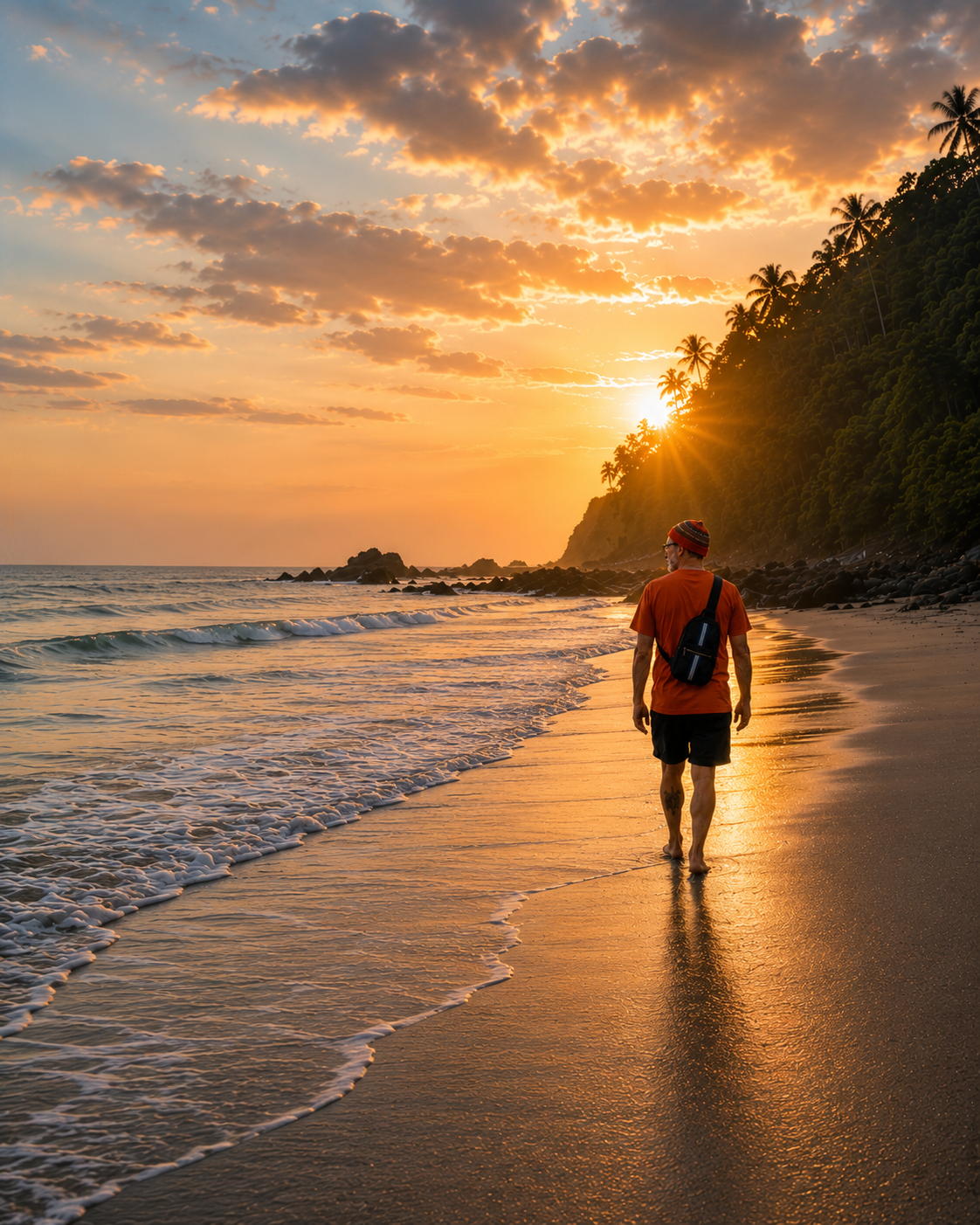
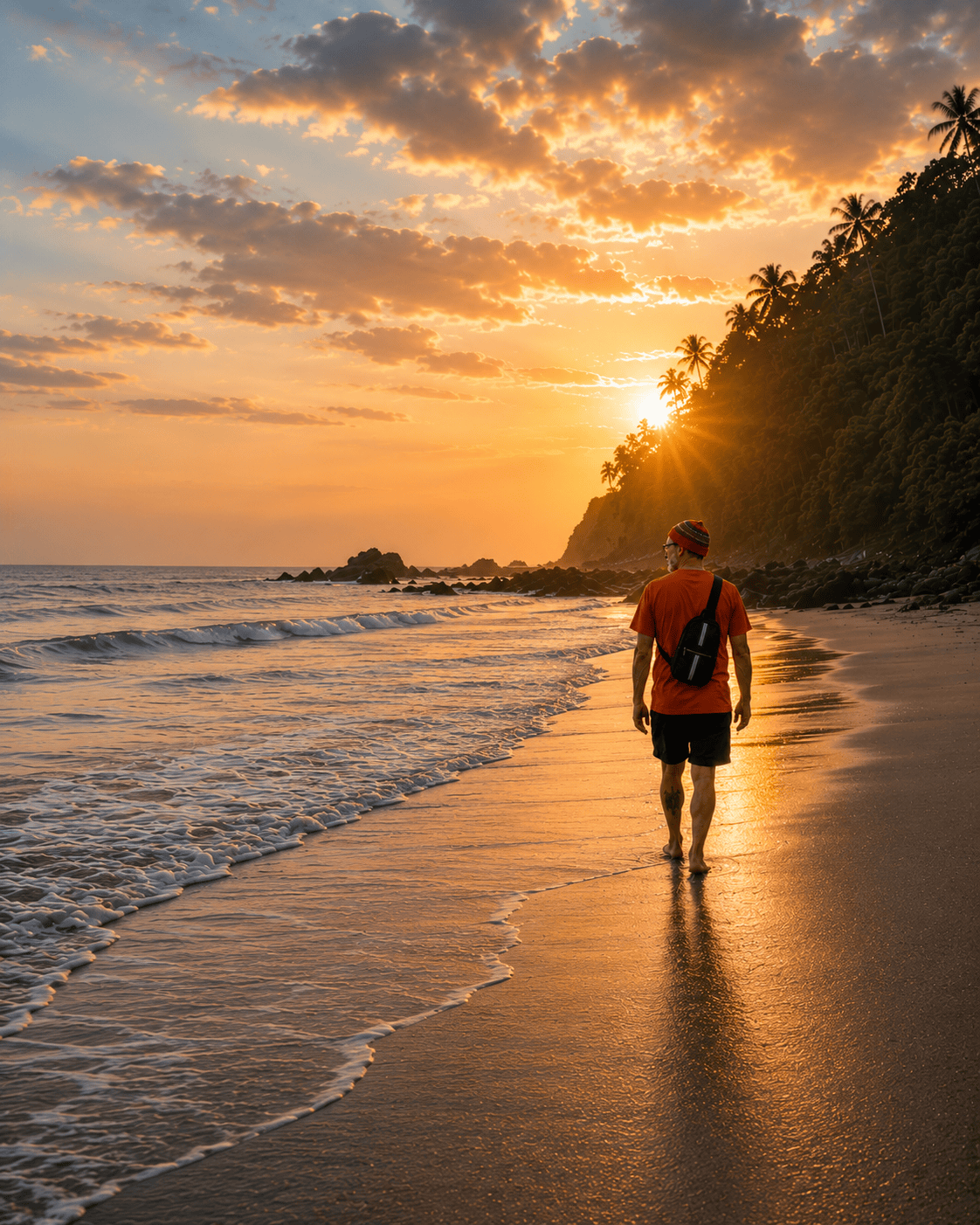
The tide here doesn't ask permission. It comes up behind you like an old friend who has decided your conversation is over, and erases the last quarter mile of your thinking without so much as an apology. I watched my own footprints disappear this sunset — neat little ovals heading north, then nothing, as if I'd never been the one walking. The Pacific has a way of editing your résumé in real time.
I should be insulted. I'm not. There's a strange relief in it, actually, watching the evidence of yourself dissolve while you're still standing there with wet ankles. The sand doesn't care that you've made it this far. It also doesn't care about the parts you wouldn't put on a tombstone — the years that nearly took you, the rooms you walked out of, the version of yourself you don't talk about much anymore. The ocean is a generous editor. It cuts everything.
I've been thinking about what we leave behind when we stop leaving footprints altogether. It's the sort of thought that ambushes you on a beach in Costa Rica, where the air is warm and you are improbably alive and somewhere a pelican is doing better at flying than you have ever done at anything. Did I live a good enough life. The question arrives uninvited, like most honest ones do.
And then, this — and I mean this plainly: I am grateful I got to ask it from here. There was a long stretch where I wouldn't have bet on being the man standing on this shoreline. The road that brought me to this water was not a scenic route. It was the kind that takes the muffler off your car and most of your certainty with it. People I loved didn't make it to their version of this beach. I did. I don't take that lightly. I try not to take it at all.
What I notice, walking back the way I came, is that the footprints don't really matter. They were never the point. The point was the walking. The point was the salt drying on my forearms, the small brown dog earlier who decided I was worth following for three hundred yards before remembering she had other appointments, the woman at the fruit stand who handed me a mango and corrected my Spanish with the patience of a saint and the directness of a grandmother. None of that leaves a mark you can photograph. All of it leaves a mark.
What Stays
Waves erase each measured track, Yet pulse through salt and air; Feet fade fast when tides pull back, But stride shapes those who stare.
Read the full poem →I think we get this backwards. We imagine legacy as something carved — a name on a building, a book on a shelf, a sentence someone might quote at our funeral if they remember to bring notes. But the people who shaped me didn't carve anything. They just showed up. They sat with me when sitting was the harder option. They said the small thing at the right moment and probably forgot they said it by Tuesday. Their footprints washed away too. What stayed was the walking they did beside me.
So maybe the question isn't did I leave something behind. Maybe it's did I show up while I was here. Did I lean toward people. Did I notice the dog, the weather, the old man at the gas station who wanted to talk about his wife. Did I let myself be touched, which is harder than touching. Did I forgive, eventually, including myself, which took the longest.
The truth I keep arriving at, slowly, on beaches and in kitchens and on the long drive home from places I shouldn't have been: I am grateful. Not in the bumper-sticker way. In the way you're grateful when you've seen the other outcome up close and walked past it anyway. The hard road taught me to recognize a soft moment when it shows up. This is a soft moment. I am trying not to miss it.
Up the beach, a wave takes the last of my prints. I watch it without sentiment. There's something almost funny about it — all that effort to walk down here, gone in a polite hiss of water. The ocean has the last word, and the word is shhh.
Fine. I'll be quiet. I'll keep walking. The mark, if there is one, isn't in the sand. It's in whoever I get to be tender with on the way back up.
Yours, in ink and embers,