I spent a Saturday in June at a gallery in Santa Fe watching people look at paintings. Not the paintings themselves — the people looking at them. There is a particular expression that happens when a painting lands on someone: a small opening in the face, a slowing of the breath. They stop moving. Something in them receives it.
That's what I want from a poem. I want the reader to stop moving for a moment. I want their breath to change. Their emotions and views challenged.
Watching people look at paintings taught me something I had known in theory and needed to see in practice: art lands in the body before it lands in language. You can see it happen. Shoulders drop. A person leans in slightly. The face opens for half a second before self-consciousness returns. I was not studying paintings that Saturday so much as I was studying receptivity, and that is a useful thing for a poet to observe. Every line I keep in a poem is trying, in some small way, to create that same pause in a reader.
Painters have access to a directness I envy. Color does not need to justify itself. Texture does not argue its case. A brushstroke can carry mood without first passing through explanation. Words are less merciful. They arrive with baggage, associations, logic, and all the old wear of usage attached to them. That is why I am so interested in poems that work as viscerally as paintings do. I want the sentence to bypass the purely rational gatekeeper and go straight into the chest, the way a field of blue or a slash of crimson can. It is a high bar, but it keeps me honest about what language can and should do.
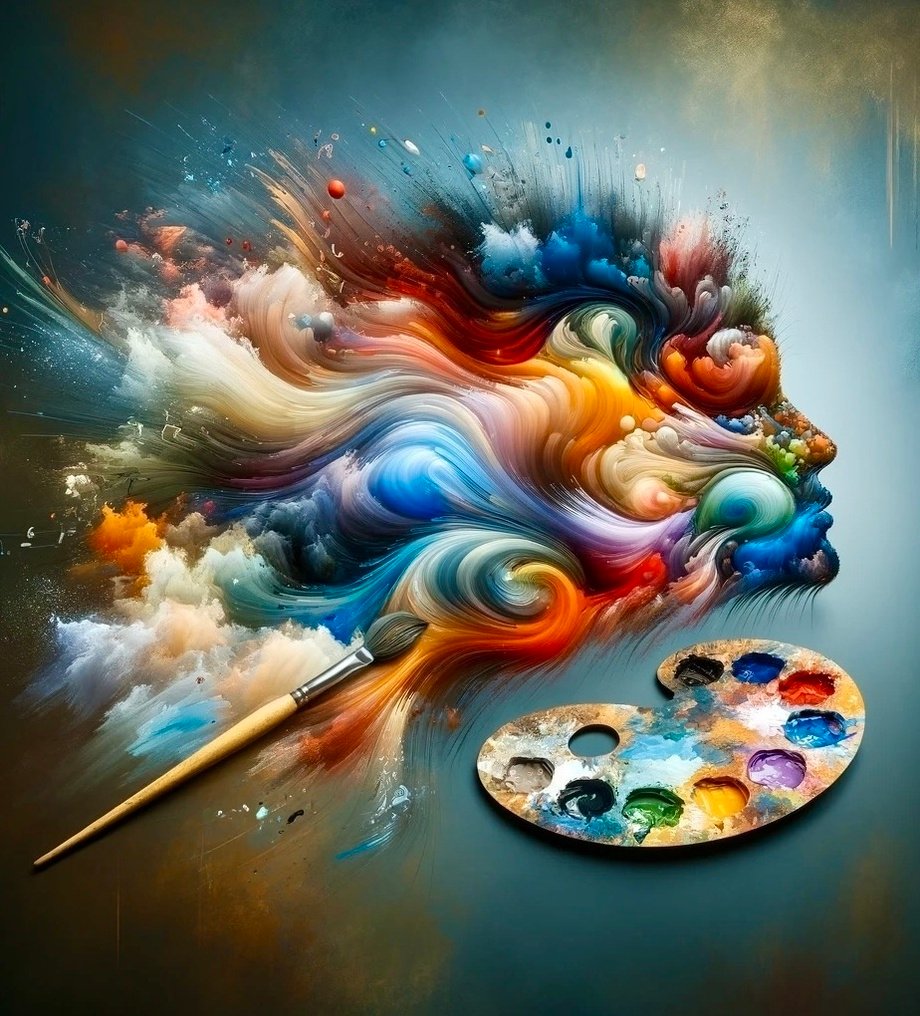
Brushstrokes of Emotions
In hues of heartbeats, rhythms align, Each stroke paints feelings, vivid and fine. Crimson for love, in passionate flight, Azure for sorrow, deep as night.
Coming soon — included in Ink and EmbersThe poem this gallery visit produced came from exactly that tension. I was thinking about color as emotional intelligence, about what painters know in their wrists that poets are always trying to learn in syntax. Crimson is not just red. Azure is not just blue. We all know more than the color wheel can tell us. The feeling content is already there, waiting to be received. That is what fascinated me in the gallery: not the theory of color, but the fact that people were clearly being moved by it faster than they could explain why.
Maybe that is why I wanted the image for the entry to be process rather than finished artifact. The palette, the brushstroke mid-gesture, the paint still deciding what it is—those things feel closer to how poems are made than the polished final canvas does. Art before it resolves is often where feeling is most naked. I trust that stage. It is messy, provisional, and alive. So is a draft. So is a human being in front of a painting they did not expect to need quite so much.
I keep going back to that small opening in a viewer's face when the work lands. It is such a brief human event and such a profound one. If a poem can do that—if it can stop motion for even a breath—then it has already accomplished more than explanation alone ever could. That gallery day reminded me what standard I am really writing toward.
I wrote this poem after that gallery visit. I was thinking about how painters get to work in a language that bypasses the rational mind entirely — you can't argue with color the way you can argue with a sentence. Words are slippery. A painting just sits there in your chest, doing what it does.
Yours, in ink and embers,